Login to access Everything Marketplaces
Don't have a member account? Join here.
Thank you! Your submission has been received!
Oops! Something went wrong while submitting the form.
We're sharing a blog post from Mike Williams on how not all GMV is created equal. This was previously shared as a post in the community here.
Hey all, I'm sharing a deep dive post I put together on why not all GMV is equal. It gets into what actually defines the quality of GMV and what separates the GMV that lasts from the GMV that doesn't, a difference that matters even more in the age of AI. I'd love to hear from you all in the comments below.
For a decade, GMV has been the number every marketplace leads with. It sits at the top of the deck, anchors the monthly update, and sets the tone for the raise, and the instinct is to read a bigger number as a stronger business. That instinct is often wrong. GMV measures the volume flowing through a marketplace, not the value it keeps, and the two come apart faster than the headline ever admits. AI is about to make that gap impossible to ignore, but it was there long before agents showed up.
The gap shows up most clearly when two marketplaces look identical on paper. Picture two of them running $20M a year at a 15% take rate. On the summary slide they are the same company. Underneath, they could not be more different. The first keeps 70% of its buyers year over year, sits on supply no competitor can easily replicate, and gets sharper at matching every time it runs. The second re-acquires most of its demand through paid channels every year, runs on supply anyone could stand up in a weekend, and loses its best relationships to off-platform deals after the first transaction. Same GMV, but one is a compounding asset and the other only looks like one right now. No serious investor pays the same multiple for both, because they aren't buying the number — they're buying what the number will still be worth in three years.
This is the core mistake, and it cuts both ways. A big number inflates weak marketplaces that bought their way there, and it buries strong ones whose smaller number is almost entirely durable. The fix is not to track GMV harder or to swap in one better metric. It is to stop treating GMV as a single thing and start reading its quality, one dimension at a time.
The most useful way to think about GMV is that every dollar of it has a half-life. Some GMV is durable: it repeats, it stays on-platform, it sits on supply that cannot leave, and it compounds into something the marketplace owns. Other GMV is decaying from the moment you book it, held in place only by continuous spend or by a lock-in that will not survive the next competitor or the next tool. Two marketplaces with identical GMV can have half-lives measured in years or in months, and the half-life, far more than the headline number, is what the business is actually worth.
You cannot see any of this in the top-line figure. You can only see it by breaking GMV down along the dimensions that drive it. There are six worth measuring, and each one is a question you can ask of your own marketplace today.
Repeat GMV compounds, while one-time GMV is a treadmill you have to re-buy every cycle. Repeat is one of the biggest drivers of half-life, because it changes the shape of the cohort curve, not just the height of a single bar. But low frequency isn't automatically weak. A low-frequency, high-value marketplace can be perfectly durable if each sale is worth enough or it wins on another axis. The fragile mix is low frequency and low value with nothing else to fall back on.
The math makes the gap obvious. Take two marketplaces that both close the year at $20M. The first retains 70% of its GMV, so it opens the following year at $14M before it signs a single new customer. The second retains 20%, so it opens at $4M and has to buy back $16M just to stand still. They finished the year in the same place, but one starts the next lap far ahead of the other, and that lead widens every year the pattern holds.
The best marketplaces build for this from the start, and some even price for it. Faire built its wholesale business on reorder behavior, charging an acquisition premium on a retailer's first order and then settling into a lower flat rate on every reorder after, because the reorder is where the durable value lives. A retailer that keeps restocking builds a cohort that compounds, which a platform serving a once-in-a-lifetime purchase like a wedding venue never gets from repeat alone. That is not a knock on the second kind; it simply has to earn its durability somewhere other than frequency. A DoorDash where the same buyer orders every week and a marketplace built on once-a-decade transactions can post the same headline GMV and sit on completely different cohort curves. Frequency is a property of the category and the product, not of the number, which is exactly why the headline hides it and a cohort curve reveals it.
GMV that you capture once but lose to disintermediation was never really yours. The first transaction happens on-platform, and then the next twenty happen over text, once both sides have each other's contact information and no longer see a reason to pay a take rate for an introduction they've already made.
Every category with high-value repeat interactions and thin platform-native workflow leaks this way. Repeated household services are the textbook case: on Rover, once a pet owner trusts a sitter, the natural next step is to book that sitter directly and leave the platform out of it, and home cleaning moves off-platform just as fast. The marketplaces that hold this GMV do it by owning something the direct relationship cannot easily replace, whether that is payments, guarantees, insurance, scheduling, or dispute resolution. TaskRabbit prices around the risk directly, taking a higher cut on a client's first booking with a tasker and a lower one on every booking after, so the incentive to go around the platform shrinks over time. Airbnb designs around it more bluntly, withholding host contact details until a booking is actually paid. The platforms that leak are the ones that treat the introduction as the product, and the introduction is the one thing a marketplace cannot charge for twice. Leaky GMV should be identified and discounted, but this almost never shows up in the headline, because the headline only counts what stayed.
If your supply is a commodity, your GMV is rented. When any competitor can assemble the same supply, demand routes to whoever bids highest for it, and your GMV leaves the moment the incentive flips. That is why rideshare spent years subsidizing both sides of the market: the drivers are largely interchangeable, so loyalty has to be bought rather than earned.
Hard supply changes the equation, because it anchors GMV in place. It is the supply that is scarce, exclusive, or expensive to assemble, and it is the reason the same demand keeps returning to the same platform. 1stDibs is the clean version. It runs a closed marketplace of vetted dealers selling one-of-a-kind antiques, art, and design that genuinely are not available anywhere else, and its own buyers name uniqueness as their single biggest reason to buy. That scarcity is the anchor. Where the supply is genuinely a commodity, the anchor has to come from somewhere else, which is what StockX and GOAT figured out. They sell the same sneakers you can find in a dozen other places, so what they defend is not the supply itself but an authentication layer a buyer will not transact without. Either way, two marketplaces can report identical GMV and carry opposite risk, one sitting on an anchor nobody else has and the other one better offer away from watching its supply leave.
GMV that throws off proprietary data is worth more than GMV that teaches you nothing, because every transaction is a chance to learn something you can compound into better matching, sharper pricing, or tighter underwriting. The marketplaces that capture that learning turn raw volume into an advantage that widens with every dollar that flows through.
Instacart is a clear example. Its search and recommendations get sharper with every order, turning a growing record of what shoppers actually buy into a matching advantage a new entrant cannot replicate without the same data behind it. Marketplaces that compound data this way get measurably better at their core job the more they run, while marketplaces that don't are really just processing payments, ending the year knowing roughly what they knew at the start. The first kind of GMV quietly builds an asset underneath the revenue. The second kind only moves money from one side of the transaction to the other.
A dollar of GMV in a clean category is worth more than a dollar in a messy one, because high-dispute, heavy-ops, fraud-prone GMV eats margin on the way through. Two platforms can report the same take rate and keep wildly different amounts of it once support, chargebacks, trust and safety, and manual intervention are subtracted out.
This is where take rate and real economics diverge. Take rate is what you charge; contribution margin per dollar of GMV is what you actually keep, and the gap between the two is where a lot of impressive-looking marketplaces come apart. Take a used-car marketplace, where every sale carries inspection, title transfer, and the occasional dispute over a lemon. Even a healthy take rate barely clears the cost of closing the deal. A digital-goods marketplace running the same take rate keeps nearly all of it, because there is nothing to inspect, no title to move, and no lemon to argue about. This dimension almost never makes the headline slide, which is why it is important to recognize and account for it internally.
Organic GMV can behave like a flywheel, and paid GMV can behave like a furnace that stops the day you stop feeding it cash. But the buy-versus-earn line matters less than what sits underneath it: whether the way you win demand has a durable edge. Paid growth at a healthy, fully-diluted payback is a genuine sign the market wants what you offer, not a weakness. The furnace is growth with no edge and no path to payback, and even word of mouth can burn out once a better-funded competitor arrives.
Two marketplaces at the same GMV, one growing on an acquisition edge that compounds and the other on tactics any competitor can copy, are not the same business wearing different logos. Etsy is the textbook version of the durable kind: buyers come for supply they can't find anywhere else and pull in more buyers by sharing what they found, so much of its demand shows up without being bought and keeps showing up. A marketplace whose growth tracks its ad budget one-to-one, with no edge in the channel, has only proven it can rent attention while the money lasts. The real tell sits underneath the buy-or-earn label: whether the edge behind the growth holds as competition arrives.
None of this is useful as a philosophy; it is useful as a scorecard. The move is to stop reporting GMV as a single figure and start reporting its mix, the same way no serious operator would report revenue without showing margins alongside it.
The simplest version fits on one line every deck should carry: durable GMV as a share of total. The fuller version is a quality breakdown that sits next to the headline number: repeat share, leakage rate, margin per dollar, the organic split, and an honest read on how defensible your supply is and how much your data compounds. Read together, those turn a flat number into a picture of its half-life. A marketplace doing $10M with 70% repeat, low leakage, healthy per-dollar margin, and mostly organic growth is a categorically different asset than a marketplace doing the same $10M with the opposite profile, and once you report the mix, you can see the difference instead of arguing about it.
The dimensions are distinct, but not all of them are independent, and reading them well means seeing where they trade off. The more workflow, payments, and guarantees you own to keep GMV from leaking off-platform, the more cost you carry, so a high score on whether it stays is often bought with a lower one on what it costs to carry. No marketplace aces all six.
A wedding-venue marketplace can carry the most coveted venues in a city and still see almost no repeat, because a couple books once and never comes back. A cleaning marketplace can have excellent frequency and still lose most of it off-platform. You are not looking for any single number to be high, or all of them at once; you are reading the shape of the whole mix and knowing which trades you are making, because a real strength on one axis does not cover a hole on another.
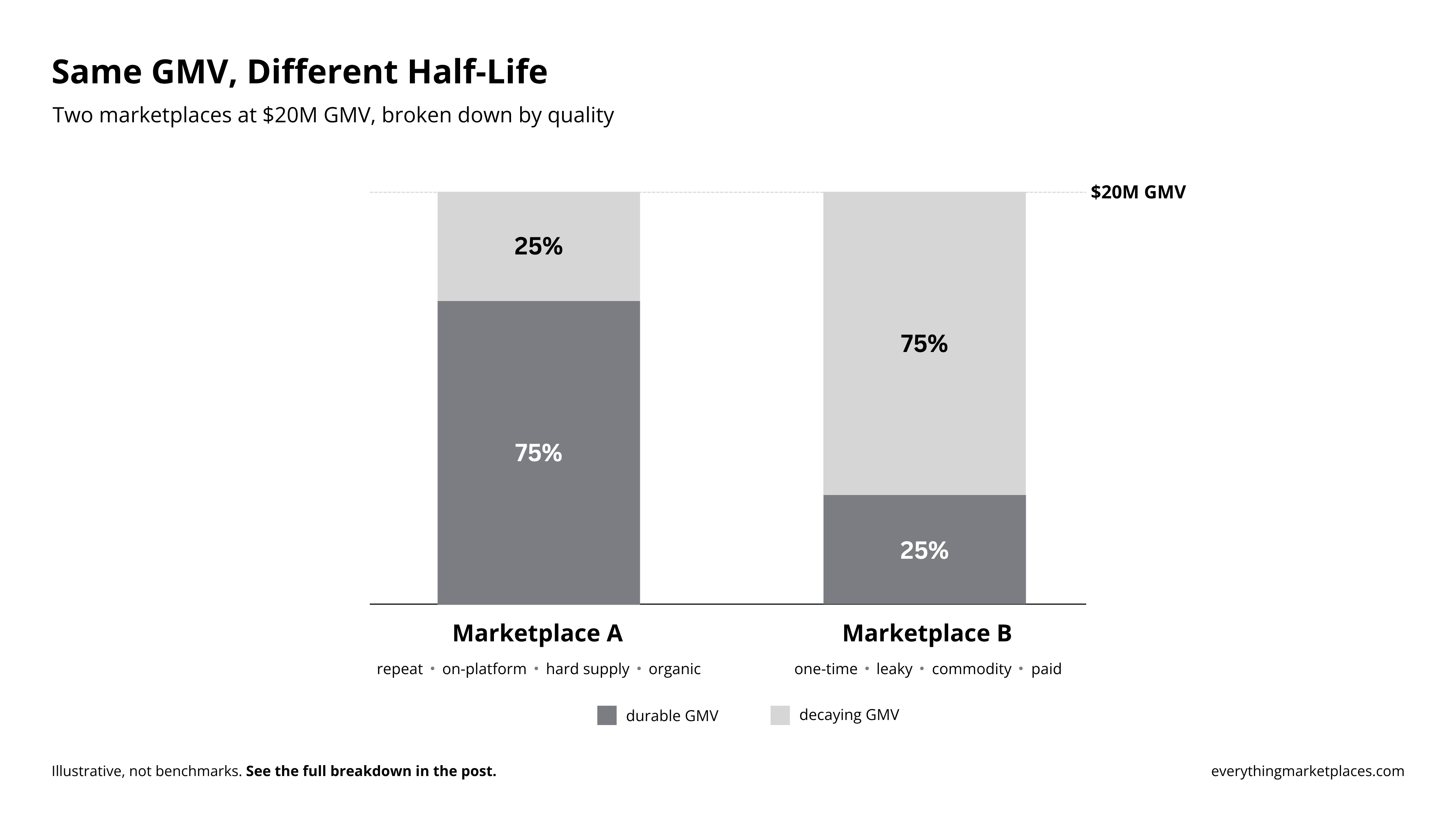
Note: Two marketplaces, one GMV number. The headline is identical. The mix, and therefore the half-life, is not. Percentages are illustrative, not benchmarks.
Read all six dimensions again through the lens of AI, and they stop being an investor's scorecard and start being a survival question, because AI changes which parts of a marketplace are actually defensible.
Generic matching is the layer AI commoditizes first. Finding, comparing, and connecting the two sides of a market is exactly what agents are getting good at, and it happens to be the part of a marketplace that used to feel like the whole thing. The matching that compounds on proprietary data is the exception, not the casualty, because an agent cannot rebuild an advantage it cannot see. When the ordinary matching approaches free, the GMV most exposed is the low-quality kind by every measure above: one-time, leaky, sitting on commodity supply, won without a durable edge, and teaching the platform nothing. That is precisely the GMV an agent can route around or a new competitor can replicate, because there is nothing underneath it holding the transaction in place.
What survives is everything the matching layer is not. Trust, accountability, deep workflow, and proprietary data are not soft extras that make a deck sound thoughtful; they are the specific reasons a transaction keeps running through you once the matching is free. The authentication that makes StockX worth using, the vetted inventory behind 1stDibs, and the purchase data compounding behind Instacart are not the matching layer, and none of them get easier for an agent to route around. Which means quality of GMV and durability in the age of AI are really the same question asked twice. The test of a marketplace is no longer how much GMV it has — it is how much of that GMV survives contact with AI.
GMV tells you how much passed through — and that is only a proxy. It does not tell you how much of it was ever really yours.
I'd love to hear how this holds up against what you're seeing. If you're a founder or investor, share your own GMV mix in the comments, especially the repeat and leakage numbers, since a framework like this is only as useful as the real-world context everyone adds to it.
The idea that not all volume is equal isn't new. Bill Gurley's "All Revenue Is Not Created Equal", Josh Breinlinger's "All GMV Is Not Created Equal", and a16z's "GMV Retention" all addressed this before. What's new here is breaking marketplace GMV into the six dimensions that drive its durability, and what AI does to each.
Thanks to Olivia Moore, Casey Winters, Colin Gardiner, and Blake Hirt for their feedback on an earlier draft.
You can connect with Mike to discuss this post in the Everything Marketplaces community here.
