Login to access Everything Marketplaces
Don't have a member account? Join here.
Thank you! Your submission has been received!
Oops! Something went wrong while submitting the form.
We're sharing a blog post from Mike Williams with a guide on how marketplaces can leverage social for distribution. This was previously shared as a post in the community here.
Hey all, I put together this 10+ page guide on how marketplaces can leverage social as a primary distribution channel. This is part of our broader theme around distribution this year, and it's something I've been seeing more of the best marketplaces use for growth. I'd love to hear from everyone in the comments below.
If you’re building a marketplace, you’re facing a math problem that gets worse every year. Spend $50 to acquire a supplier. Spend another $30 to acquire a buyer. You’re starting at -$80 before the first transaction happens. For early-stage marketplaces operating on thin margins, this problem can kill you before you reach scale.
The bigger issue with paid acquisition: you’re paying for each user individually with no compounding effect. That $50 supplier acquisition, they transact, and that’s it. The ROI is linear. Paid channels don’t create network effects — they just fill them.
Social presence works differently. When you post about a supplier earning $8K/month on your platform, you’re simultaneously recruiting new suppliers and showing buyers the quality of supply on your marketplace. One piece of content, two audiences, one fraction of the cost.
The best marketplaces in 2026 aren’t using social as a nice-to-have marketing channel. They’re using it as their primary distribution mechanism because it solves the two-sided acquisition problem in a way that actually scales economically. Paid acquisition costs continue rising while organic reach through social compounds over time. Every post, every follower, every piece of content you created six months ago is still working for you today.
Three structural market shifts have made social presence the primary distribution channel for marketplaces in 2026, and understanding these shifts explains why the strategies below work.
The economic case: Paid acquisition broke
iOS 14.5 fundamentally changed targeting effectiveness in 2021. Facebook and Google CPMs have increased significantly for many categories since then while conversion rates declined. The arbitrage that made performance marketing work for early-stage companies has largely disappeared. Marketplaces that could acquire users for $20-30 in 2020 now face $50-80 CACs for the same quality. The economics don’t work at the early stage anymore.
The algorithmic shift: Platforms favor authentic content
Between 2024-2025, major platforms made changes that reduced reach for branded content while amplifying creator and user-generated content. Instagram increasingly prioritizes original content and Reels over brand posts. This isn’t temporary. Platforms make more money when users engage with authentic content because it keeps them on-platform longer. Marketplace content (featuring real suppliers, real buyers, real transactions) performs better than traditional brand marketing in this environment.
The infrastructure shift: Creator economy matured
UGC and creator partnerships were expensive and complex three years ago. Now there are established playbooks and accessible talent pools. Micro-creators (5K-50K followers) create authentic marketplace content for $100-500 per video, a fraction of what paid ads cost with better engagement. This makes sophisticated social strategies accessible to early-stage teams.
These market shifts enabled three distinct approaches that successful marketplaces use for social distribution.
Supply Amplification works by leveraging your suppliers’ existing audiences. When you make it easy for suppliers to share their marketplace success, you access distribution you could never build yourself. Poshmark sellers sharing closets, Whatnot sellers promoting live shows, and Whop creators announcing earnings all extend your reach without adding cost.
Cultural Integration works by becoming part of the cultural conversation in your category, not just a place to transact. When your marketplace participates in trends, creates category-defining content, and engages at a level that feels native to platform culture, you attract both sides organically. Grailed in streetwear hype, Vinted in sustainable fashion, and StockX in sneaker market data all demonstrate this approach.
Data Authority works by owning the insights that matter to your market. When your marketplace generates proprietary data that suppliers and buyers need to make decisions, you become the source of truth. StockX publishing resale pricing trends, Faire sharing wholesale insights, and Upwork publishing freelance rate data all position their marketplaces as essential category infrastructure, not just transaction platforms.
Most marketplaces start with one approach based on their category, then layer in others as they scale. The platforms below each enable different combinations of these strategies.
Pick 1-2 platforms maximum to start. Going deep on one platform beats spreading thin across many.
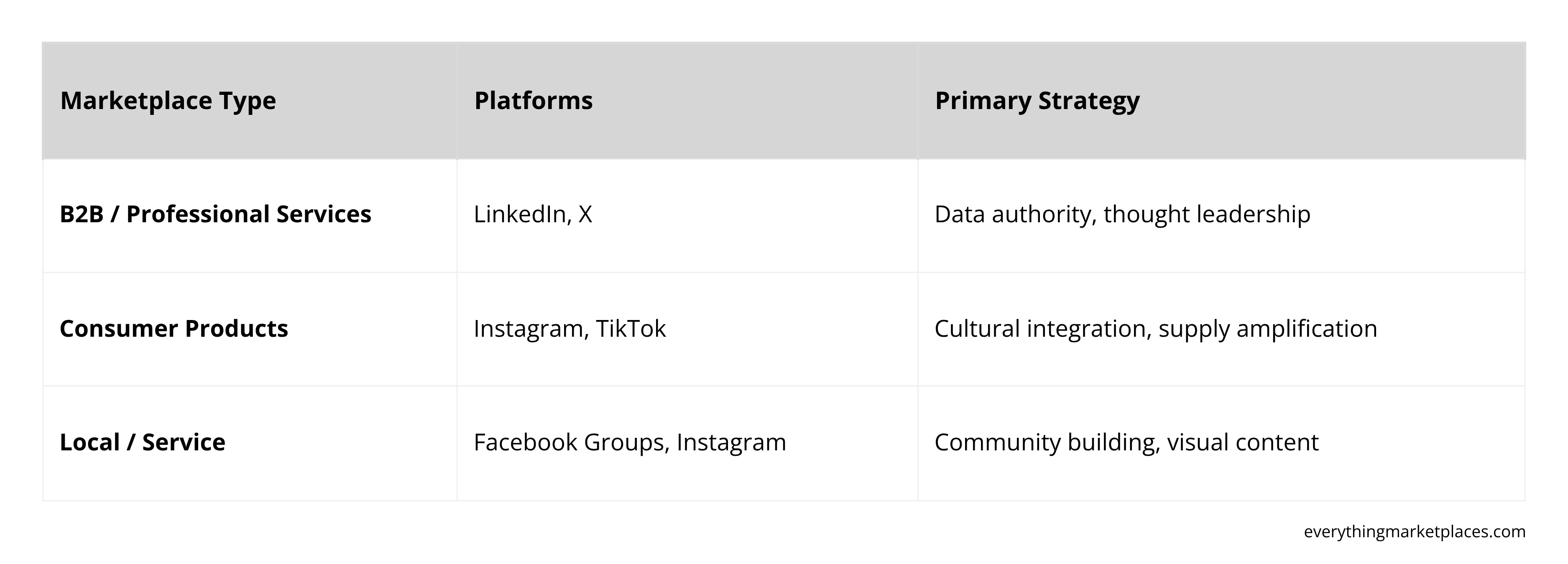
High-frequency marketplaces should start with 2 platforms and post daily. Your users are active, so consistency matters more than polish.
Low-frequency marketplaces should start with 1 platform and focus on evergreen content. Quality over volume since users don’t return as often.
Primary strategies: Supply Amplification + Data Authority
X’s public, conversational structure makes it uniquely suited for marketplaces to build community with both sides simultaneously. When potential suppliers see you publicly celebrating other suppliers, they understand the platform values them. When buyers see those same posts, they see social proof of quality supply. The conversation happens in public, which creates network effects that closed channels can’t match.
The platform is particularly strong for B2B marketplaces, professional services platforms, and categories where suppliers and buyers are active in industry conversations. A single well-engaged thread can reach thousands of qualified prospects at zero marginal cost.
One important note: X engagement has been declining across most industries and the platform is more variable than others. It performs best for tight niche communities, so treat your X benchmarks as the most platform-dependent of any channel here, and don’t over-invest before you have proof it’s converting for your specific category.
How top marketplaces use X
Airbnb was notably host-first in its early X presence, amplifying exceptional listings, publicly celebrating hosts, and positioning the platform as being on the host’s side when competitors focused exclusively on buyers.
Etsy highlights weird, specific products that make people stop scrolling. "Someone on Etsy is selling hand-carved wooden spoons shaped like different dog breeds" entertains existing followers while showing sellers what unique inventory thrives on their platform.
StockX publishes real-time pricing data and market movements with charts. This positions them as the authority on market value while driving both sellers (capitalizing on trends) and buyers (hunting deals). The data comes from their marketplace, creating a moat competitors can’t replicate.
Whop features creator success stories with real earnings. Quote-tweeting creators announcing "$50K/month selling my Discord community on Whop" with dashboard screenshots drives both supply (showing what’s possible) and demand (social proof).
Tactical playbook
For supply-side growth: Share supplier earnings threads with real numbers and specific tactics. Run monthly X Spaces with successful suppliers sharing strategies. Quote-tweet suppliers sharing their success to amplify their reach.
For demand-side growth: Showcase unusual inventory that demonstrates marketplace depth. Post category trends with proprietary data ("Vintage denim up 40% this month"). Create FOMO around limited drops and trending items.
Post 1-3 times daily. Track link clicks to marketplace, supplier signups (UTM parameters), thread engagement rates.
Primary strategies: Cultural Integration + Supply Amplification
Instagram’s strength for marketplaces is that the platform rewards aspiration and community in ways other channels don’t. For marketplaces with visually interesting supply (products, spaces, experiences, creative work), Instagram creates discovery mechanics that paid ads can’t replicate. The Explore page, hashtag discovery, and algorithmic feed surface content based on engagement, not payment.
This matters because marketplace content performs differently than brand content. When you feature a supplier’s product or story, it carries authenticity that polished brand content lacks. The algorithm recognizes this engagement pattern and amplifies it.
How top marketplaces use Instagram
Poshmark built massive supplier-side growth by making reselling look fun and social. Their feed features predominantly seller content, including seller success transformations and monthly styling challenges. Making sellers the heroes repositioned selling as joining a community, not starting a business, lowering the barrier to entry.
Depop’s Instagram feels like a fashion magazine built by Gen Z. They curate seller content with editorial photography and styling videos. Treating secondhand shopping as creative expression, not budget shopping, completely repositioned how their demographic perceives the category.
Hipcamp uses stunning host-submitted photos of unique stays (treehouses, Airstreams, geodesic domes) that drive significant weekly booking traffic organically. They feature new stays within 24 hours. Each post books the property, attracts similar hosts, and positions Hipcamp as the place for unique stays.
Tactical playbook
For supply-side growth: Post before/after revenue transformations with charts and metrics. Create carousel posts (8-10 slides) breaking down successful supplier strategies. Use Reels showing supplier workspace, packing process, or earnings reveals. Run "Meet the Seller" series with their story and products.
For demand-side growth: Curate inventory into thematic posts (seasonal, style-focused, price-point collections). Use Instagram Shopping to tag products directly. Feature customer unboxing videos and testimonials. Create product styling content showing items in different contexts.
Content mix as a starting point: lean heavily on user-generated content from both sides, support with educational content, and keep promotional posts minimal.
Post 4-5 times weekly, daily Stories, 3-4 Reels weekly. Track Instagram Shopping clicks, Stories link clicks, social-attributed transactions.
Primary strategies: Cultural Integration + Supply Amplification
TikTok’s algorithm prioritizes content quality over follower count, which means a brand-new account can reach millions if content resonates. For marketplaces targeting younger demographics or categories with strong visual interest, this creates asymmetric distribution opportunities. The platform rewards authenticity over polish, making it accessible for resource-constrained teams.
Most importantly, TikTok users discover products and services through the platform, not just entertainment. When a marketplace can tap into this discovery behavior, social presence becomes actual purchase behavior at scale.
Note: TikTok’s regulatory situation in the US continues to evolve, so verify availability and build your presence on a second platform in parallel.
How top marketplaces use TikTok
Whatnot generated enormous organic reach through seller success content. Videos of resellers showing earnings (with screen recording proof) routinely hit millions of views. "I made $15K last month selling Pokemon cards on Whatnot" drives both supplier applications and buyer signups simultaneously.
Vinted made secondhand shopping culturally cool with Gen Z by creating content that feels like TikTok, not marketing. They participate in "thrift flip" trends and "haul" videos. Their content doesn’t feel like a brand — it feels like TikTok content that happens to feature their marketplace.
Grailed taps into streetwear hype culture by featuring rare finds and price comparisons using trending sounds. Their comment section becomes a community discussing authenticity and pricing. By positioning themselves as culturally fluent rather than purely transactional, they attract the exact supply and demand they need.
Tactical playbook
For supply-side growth: Create earnings reveals with screen recording proof. Post "get ready with me to ship orders" content from successful sellers. Create educational content on avoiding common seller mistakes.
For demand-side growth: "You won’t believe what I found" videos featuring unusual products. "Finds under $X" compilation videos (15-30 seconds, fast-paced). Product comparison content showing retail price vs. marketplace price.
Post daily if possible (algorithm rewards consistency), minimum 5 per week. Use trending sounds within 24-48 hours of emergence. Engage with all comments in first hour. Track views, completion rate, shares, profile visits, link clicks.
Primary strategy: Supply Amplification (through peer support)
Facebook Groups create the strongest community dynamics of any social platform. While the main Facebook feed may feel dated, Groups remain incredibly powerful for building peer-to-peer communities, facilitating knowledge sharing, and creating switching costs that paid acquisition never generates.
The strategic value for marketplaces: Groups transform your platform from a transaction tool into a community. When suppliers help each other troubleshoot problems, share optimization tactics, and celebrate wins together, they’re no longer just using your marketplace. They’re part of something bigger.
How top marketplaces use Facebook Groups
Whatnot runs official seller community Groups where live sellers share show schedules, coordinate drops, and help each other troubleshoot. The Groups give sellers practical value beyond the transaction layer, covering show timing, pricing strategy, and buyer engagement tactics, and create switching costs that no competitor can replicate by just building a better product.
Poshmark sellers run private Groups coordinating "sharing parties," discussing pricing strategies, and supporting each other. The groups provide practical value (better visibility through coordinated sharing) and emotional belonging.
Rover built active sitter and dog walker Groups where providers share pet care tips, handle difficult booking situations, and celebrate reviews, turning independent contractors into a community with real loyalty to the platform. A sitter embedded in a Rover community group is far less likely to leave than one transacting in isolation.
Tactical playbook
For supply-side: Create a private seller group and approve members manually initially. Post 3-4 times weekly with discussion prompts, not just announcements. Host monthly live Q&As with top performers. Create weekly recurring threads ("Monday Wins," "Friday Questions"). Share exclusive platform data and early feature access. Welcome every new member personally and respond to questions within 2 hours. Highlight helpful members weekly and run monthly challenges with prizes.
For demand-side: Create public groups around your category (not just your brand). For local marketplaces, leverage neighborhood groups carefully, add value, don’t spam.
Track daily active users as a percentage of total members, response time to questions, percentage of questions answered by peers vs. moderators (target 70%+ peer-to-peer), and member retention after 90 days.
Primary strategy: Data Authority + Supply Amplification
For B2B marketplaces, professional services platforms, and career-related offerings, LinkedIn is essential because the platform algorithmically favors professional content and both your buyers and suppliers are already there in a professional mindset. LinkedIn users are open to business solutions in ways they’re not on entertainment-focused platforms.
The platform rewards thought leadership and data-driven content. A well-researched industry analysis or original data report can generate thousands of views and dozens of qualified inbound leads. For marketplaces, this creates a flywheel: publish insights from marketplace data → attract suppliers and buyers interested in those insights → generate more data → publish better insights.
How top marketplaces use LinkedIn
Upwork features detailed freelancer success stories with concrete metrics, positioning the platform as a viable path to professional independence. Video case studies (2-3 minutes), carousel PDFs with insights, and founder thought leadership about the future of work drive quality supply.
Fiverr highlights seller milestone moments like first order, first $10K month, and top-rated status, making the journey to freelance success feel achievable and aspirational for new suppliers.
Faire positions itself as the solution to wholesale procurement through educational content. They publish carousel PDFs with retail buying best practices and trend reports based on proprietary marketplace data. Leading with education, not product pitches.
Flexport’s founder Ryan Petersen built significant brand authority on LinkedIn through thought leadership on freight market conditions, carrier economics, and supply chain inefficiencies. Posts grounded in real data from their own platform positioned Flexport as a category expert, not just a transaction layer, and drove both shipper and carrier interest in the process. For B2B marketplace founders, proprietary data from your own marketplace is your most defensible content asset on LinkedIn.
Tactical playbook
For supply-side growth: Share success stories with specific metrics. Publish long-form articles (800-1200 words) about industry trends. Create carousel PDFs with frameworks. Post video case studies (2-3 minutes) with successful service providers.
For demand-side growth: Position your marketplace as a solution to business challenges (hiring, procurement). Share industry insights and proprietary data from your marketplace. Create case studies with ROI metrics. Host LinkedIn Live events discussing industry challenges.
Post 2-3 times weekly from the company page. Founders should post 1-2 times weekly, as founder accounts often outperform company pages 3-5x in reach.
Track engagement rate, article reads, profile views, connection requests from target segments, and social-attributed enterprise inquiries.
Organic social builds the foundation. Paid amplification accelerates what’s already working. The key is sequence: build organic presence for 60-90 days, identify your top-performing content by engagement and conversion, then amplify those proven winners with paid spend.
When to start spending
Don’t run paid social until you have organic proof points. You’re ready when you have 3-5 content formats consistently driving marketplace signups, UTM tracking set up to measure conversion, 1,000+ engaged followers on at least one platform, and a baseline organic cost-per-acquisition to compare against.
Three paid approaches
Boost what’s already working. The highest ROI strategy is boosting organic content that already performs well. If a Reel about supplier earnings got 50K views and drove 20 signups organically, spend $200 to push it to 200K views. You’re amplifying proven content, not gambling on untested ads.
UGC creator programs. Pay micro-creators (5K-50K followers) $100-500 per video to create content featuring your marketplace. They make authentic content ("How I use [marketplace]," product finds, earnings reveals) that you can repurpose, plus they post to their audiences and tag you.
Micro-influencer partnerships. Different from UGC creators. Partner with influencers who have established authority in your category. For supply-side: business/side-hustle influencers testing your platform for 30 days. For demand-side: category-specific influencers showcasing products/services. Track with affiliate links or promo codes.
Starting budget: $500-1,000/month split across boosting proven content (70%) and creator/influencer tests (30%). Track cost-per-signup and compare to other channels.
Key principle: Paid amplifies organic strategy, it doesn’t replace it. If your organic content doesn’t convert, paid spend just wastes money faster. Build the organic foundation first.
For detailed guidance on vetting creators, budget allocation frameworks, and platform-specific boost strategies, see the Paid Social & Creator Partnerships Playbook in Additional Resources.
Social presence doesn’t exist in isolation — it creates compounding effects across your entire distribution strategy.
SEO impact. When suppliers share marketplace content with their audiences, you gain natural backlinks. User-generated content from suppliers creates thousands of indexed pages (storefronts, profiles, listings). Platforms with strong social presence tend to generate more natural backlinks and indexed pages, both of which improve search visibility over time.
Influencer marketing leverage. An active social presence makes influencer partnerships dramatically more effective. Influencers research brands before partnerships, and strong organic social demonstrates legitimacy and audience engagement. When influencers post about your marketplace, their content performs better if your brand account is active and engaging. Micro-influencers often discover marketplaces through organic social before any paid partnership.
Trust building with demand. Organic social performance creates trust signals that paid advertising cannot replicate. Buyers researching your marketplace will check your social presence before transacting. Active engagement, real supplier stories, and authentic content signal legitimacy. A marketplace with 10K engaged followers and active conversation feels more trustworthy than one with 100K followers and zero engagement. This trust factor directly impacts conversion rates, and buyers are more likely to complete first transactions when they’ve seen authentic social proof.
Content repurposing system
Don’t create unique content for every platform from scratch. Create one substantial piece monthly (a 30-minute supplier interview, detailed case study with metrics, or original data analysis). Then atomize it into platform-specific formats: X thread with key insights, Instagram carousel (8-10 slides) with key insights, TikTok short videos (30-45 sec each), LinkedIn long-form article, Facebook Group discussion post.
Critical principle: Execution must feel native to each platform. LinkedIn should be professional and data-driven. TikTok needs fast pacing and trending sounds. Don’t cross-post identical content.
Measuring what matters
Track business outcomes, not vanity metrics.
Core metrics to track: social-attributed signups (supply and demand separately via UTM parameters), social-attributed GMV, engagement rate by platform and content type, click-through rate to marketplace, and conversion rate from follower to user.
Red flags to watch for: high followers with low engagement (wrong audience or bought followers), high engagement with low conversions (entertaining but not relevant), follower spikes with no traffic increase.
Use platform-native analytics plus Google Analytics with UTM parameters. Build a simple weekly dashboard tracking these metrics by platform.
For detailed dashboard templates and category-specific benchmarks, see the Marketplace Social Media Benchmarks guide in Additional Resources.
Month 1: Foundation. Pick 1-2 platforms where your audiences actually spend time. Post 2-3 times per week. Set up UTM tracking. Engage daily with comments and DMs. Create 10-15 pieces of evergreen content. Goals: 100-500 followers per platform, 10-50 visits from social, 1-5 signups.
Month 2: Momentum. Increase to 4-5 posts per week. Launch your first UGC campaign. Experiment with one platform feature (Stories, Spaces, challenges). Feature 2-4 suppliers in content. Goals: 500-1,000 followers, 50-100 visits per week, 5-15 signups per month.
Month 3: Systems. Create templates for recurring posts. Build a posting schedule. Start repurposing content across platforms. Launch a community space (Facebook Group, Discord, or LinkedIn Group). Goals: 1,000-2,000 followers, 100-200 visits per week, 10-30 signups per month, 50+ community members.
Consistency beats heroics. Better to post 3x per week for a year than daily for a month then burn out.
For detailed implementation checklists and quarterly planning frameworks, see the Social Media Strategy & Implementation Guide in Additional Resources.
AI-powered content creation is reducing manual effort, but strategy and positioning matter more than volume. Video-first is permanent across all platforms, and text and image-only strategies now significantly underperform. Paid and organic are converging through creator partnerships. Platform fragmentation continues, so pick 2-3 platforms that actually move your metrics and go deep rather than spreading thin.
Trust has become the primary competitive advantage. As marketplaces proliferate, buyers increasingly rely on organic social signals to evaluate legitimacy before transacting. Marketplaces with authentic social presence — real supplier stories, genuine community engagement, transparent communication — convert significantly better than those relying solely on paid acquisition. This trust advantage compounds: engaged social audiences become repeat customers and refer others, creating acquisition loops that paid channels can’t replicate.
The distribution advantage goes to marketplaces that show up consistently with authentic value, build genuine community with both sides of their platform, and integrate social presence into core growth strategy rather than treating it as an afterthought.
In 2026, the best marketplaces are proving that social distribution isn’t just cheaper than paid acquisition, it’s more effective, more defensible, and it compounds over time in ways that paid channels never will. The question isn’t whether to invest in social presence. It’s whether you’re willing to start building the compounding advantage today that will define your competitive position three years from now.
Social presence in 2026 isn’t supplementary marketing for marketplaces. It’s core distribution infrastructure that solves the fundamental challenge of simultaneously attracting supply and demand in a capital-efficient way.
Downloadable reference materials to accompany this post:
I'd love to hear what's working for your marketplace in the comments below, and happy to go deeper on any section.
You can connect with Mike to discuss this post in the Everything Marketplaces community here.
