Login to access Everything Marketplaces
Don't have a member account? Join here.
Thank you! Your submission has been received!
Oops! Something went wrong while submitting the form.
We're sharing a blog post from Mike Williams, covering a framework marketplaces can use for supply to drive demand. This was previously shared as a post in the community here.
As we all know, building a marketplace and solving for demand (usually the hard side) is challenging. A proven strategy for addressing this is using supply to help drive demand. This is also part of our theme for distribution this year, so I wanted to put together a post covering a framework you can use for supply-to-demand growth and 15 specific tactics.
One important caveat: This assumes you’re adding meaningful value to transactions, giving supply a reason to bring or drive demand and not go off-platform.
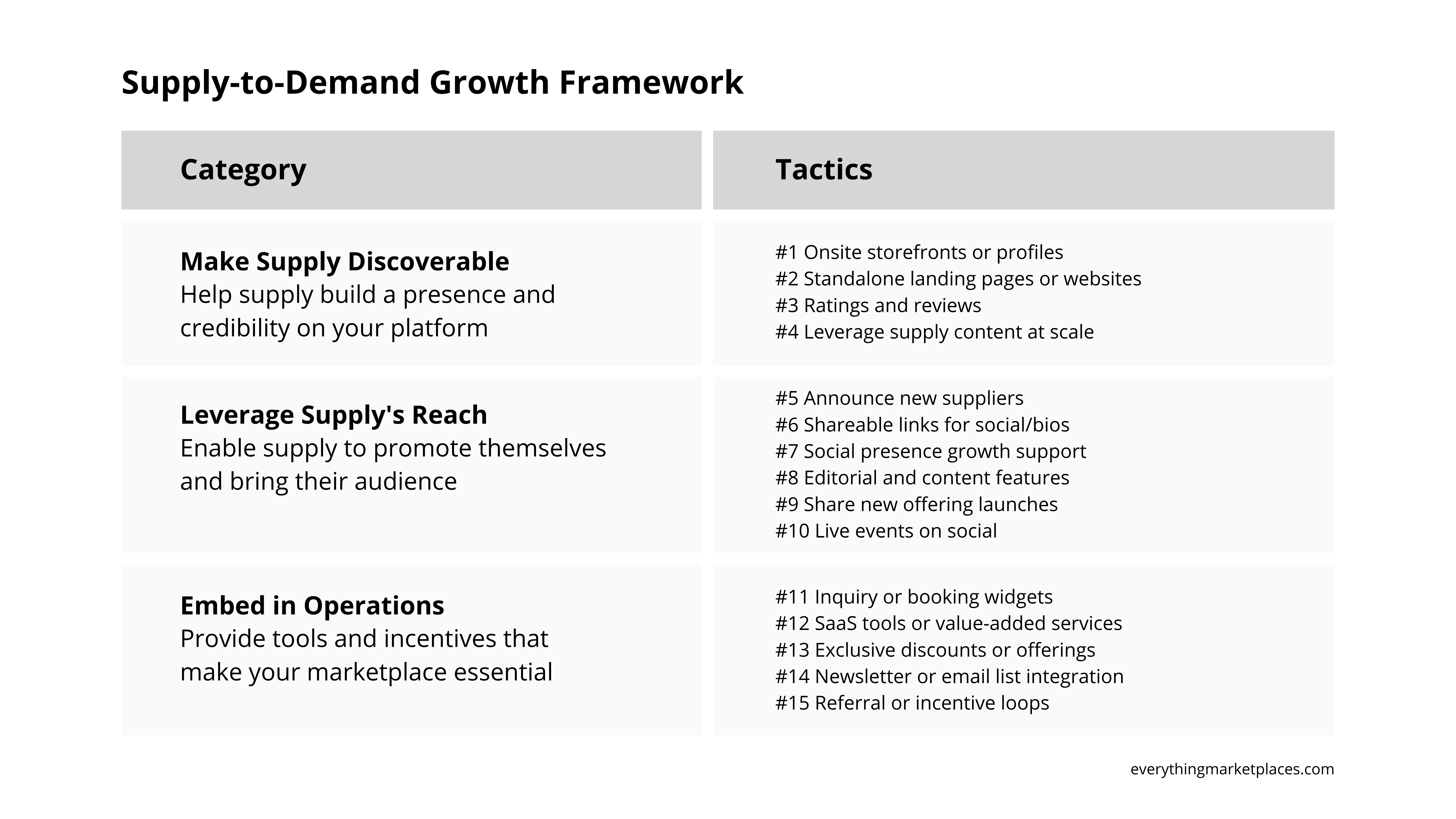
The most common ways marketplaces use supply to drive demand fall into three buckets: making supply more discoverable, leveraging supply’s reach, and embedding into operations or workflows.
Here are 15 tactics grouped into each bucket for how marketplaces can use supply to drive demand:
1. Create onsite storefronts or profiles for supply
Create onsite storefronts or profiles for supply that are crawlable and optimized for capturing high‑intent queries from search traffic.
Examples: Etsy storefronts, Airbnb host profiles, Upwork freelancer profiles.
2. Create standalone landing pages or simple websites for supply
For suppliers without a strong online presence, create marketplace-powered landing pages or simple websites to attract search traffic and convert high-intent interest (offsite) to the marketplace.
Examples: Booking pages for hotel or boutique travel providers, websites for local SMBs and service providers.
3. Incentivize supply to create ratings and reviews
Encourage suppliers to bring over existing customers to leave reviews, boosting their visibility and credibility. You can reward this by boosting rankings in search results.
Examples: Airbnb host reviews, Hipcamp reviews, service marketplace testimonials.
4. Leverage supply content for discovery at scale
Leverage supply-created content (photos, inventory availability, pricing, reviews) to power SEO/AEO, paid ads, PR, and marketplace discovery.
Examples: Hipcamp listing photos, StockX inventory and pricing data.
5. Announce new suppliers joining the marketplace
Turn supply onboarding into a distribution moment. Announce new suppliers via social, email, or content, and provide them with suggested copy and timing so they can reshare.
Examples: Intro Expert announcements, MentorPass Mentor announcements.
6. Create shareable links and encourage supply to feature as links in social bios
Provide supply with clean, shareable links to storefronts, profiles, or listings and encourage them to be used on social and as links in bio.
Examples: Whatnot, Palmstreet, Etsy, and Reverb seller links for social profiles on TikTok and Instagram.
7. Help supply launch and grow their social presence
Support suppliers without an established social presence in building an off-platform audience through guides, templates, workshops, or resources. A larger supplier audience drives more traffic and demand to their marketplace listings.
Examples: Hipcamp host social resources, Etsy seller education initiatives.
8. Highlight or feature supply through editorial and content strategies
Feature suppliers in interviews, blog posts, newsletters, or video content. This increases supplier visibility, builds credibility, and encourages sharing with their audiences.
Examples: eBay seller spotlights, Turo host features, Leland coaching content.
9. Encourage supply to share new product or service launches
Encourage supply to promote new offerings directly to their audience, generating traffic and interest for their marketplace listings.
Example: Hipcamp hosts announcing a new glamping tent.
10. Leverage supply’s social networks for live events
Use supply to host live streams, sales, or live demos linking back to their listings, generating trust and demand in addition to sales.
Examples: Whatnot and Palmstreet resellers streaming sales for rare items on Instagram or TikTok.
11. Offer inquiry or booking widgets for supplier websites
Create an inquiry or booking widget for supply to embed directly on their website. This captures traffic and routes transactions through your marketplace.
Examples: Booking widgets, request-a-quote embeds, availability calendar embeds.
12. Give supply SaaS tools or value-added services that make bringing demand worthwhile
Equip supply with SaaS tools to run their business more efficiently. The key is software they’ll use daily, like booking systems, payment processing, customer communication or fulfillment tools. These improve their ability to be more successful through your marketplace and increase their incentive to bring or send customers to your marketplace, rather than going direct or off-platform.
Examples: Inquiry auto replies, booking and calendar management software, payments, dynamic pricing recommendations, financing, fulfillment solutions.
13. Let supply create exclusive discounts or offerings
Allow suppliers to create first-time offers, early access, or even bundle items for their audience. This creates urgency for demand.
Examples: Etsy seller bundles shared on social, Faire’s "Featured Collections", which brands can promote directly to buyers.
14. Encourage integrations into newsletters or email lists to drive buyers
Encourage supply to feature marketplace listings in their newsletters, or send direct emails to past customers, driving higher-converting traffic.
Example: Palmstreet resellers sending "new arrival" emails linking to listings.
15. Create supply referral or incentive loops
Reward supply for bringing demand through incentives or referrals. You can reward this through financial incentives or boosting marketplace rankings. This turns supply into a micro-distribution engine.
Example: Ride-share drivers offering discounts via referral links.
Here’s a visual framework that simplifies how marketplaces use supply to drive demand:
You can also see the following resource: 5-step playbook & checklist for using supply to drive demand
The best marketplaces don’t just acquire supply, they make it part of their growth flywheel. By focusing on discovery, leveraging supply’s reach, and embedding into operations or workflows, supply becomes a powerful engine for driving demand.
I’d be happy to expand on this or share more examples in the comments below. It would be great to also hear from the community and how everyone might be leveraging supply for driving growth.
You can connect with Mike to discuss this post in the Everything Marketplaces community here.
